APPENDIX A
If, however, B accomplishes this before A gets to his proper side, then A loses the Right of Way to B.
If B can unquestionably reach the ball at X without interfering with A's stroke or causing him to check in the slightest degree to avoid the risk of a collision, then he may take on off-side backhander at B'. But if there is the slightest doubt about B riding clear of A, then A's Right of Way holds good and B's only chance of hitting the ball is to swerve towards B", keeping clear of the Right of Way, and take a nearside backhander, if in taking this backhander, or afterwards, his mount in the slightest degree enters the Right of Way, he infringes.
B is entitled to the Right of Way because he is meeting the ball on its exact line to take it on his off-side. C must not cross this Right of Way. The only way for the team hitting in to take the ball on, is for A to follow its line and take an offside shot, because A and B are each entitled to their own Right of Way, which are clear of one another.
The Back (Red) and No. 1 (Blue) are following up the line of the ball, riding each other off. These two players share the Right of Way, as shown, and no other player or players (Red or Blue) may cross or enter this Right of Way, even if meeting the ball on its exact line.
Neither A nor B hit it there, but the striker is not near enough to the ball to risk a collision with either. Both start to ride to the ball with equal rights. A collision appears probable at X. A has the Right of Way. As shown he followed more closely the line on which the ball has been travelling.
Although B hit the ball last he has failed to obtain the Right of Way because he has failed to follow the ball on its exact new line without deviation, whereas A has ridden on a line closer and more nearly parallel to the new line of the ball. A is therefore entitled to the Right of Way.
The Back (Blue) rides for the ball. The No. 1 (Red) goes with him riding him off all the way. A collision appears probable at X. No. 1 (Red) will commit a dangerous foul if he fails to give way and consequently:-
Note: In case (a) the Umpire must observe closely whether the Back (blue) fouls by riding across the Right of Way of his own free will or whether the No. 1 (Red) fouls, by forcing him across it. |


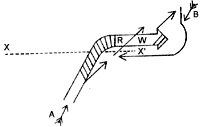 The ball has been hit from X and is about to stop at X’. A is riding in the general direction in which the ball is travelling and provided he rides to take the ball on his off-side (which will necessitate his swerving to the left of the course as he is shown below) he will be entitled to the Right of Way shown. In this case B can meet the ball safely at X' only if he can cross over to his proper side of the line before A straightens out on the line.
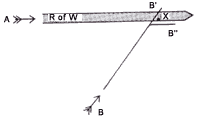 A hits the ball to X; and follows the line to take it on his off side. This entitles him to the Right of Way, as shown.
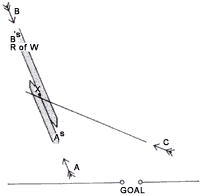 A hits the ball in from behind to X, B rides to meet it and C to take it on his off side. A collision is imminent between B and C at X.
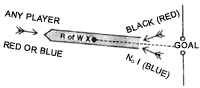 The ball has been hit from the mouth of the goal to X.
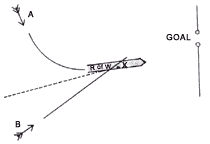 The ball has been hit to X
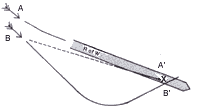 B hits the ball under his pony's neck to X and swings round in a semi-circle to B' A follows the line of the ball to A'. At A', B' a collision is imminent.
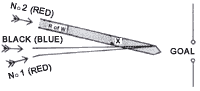 No. 2 (Red) hits the ball to X and
follows its line to take it again on his off-side. He is therefore entitled to the Right of Way, as shown.
No. 2 (Red) hits the ball to X and
follows its line to take it again on his off-side. He is therefore entitled to the Right of Way, as shown.